
Fulgeanu 85
Miruna Fulgeanu
Destruction as the Cause of Coming into Being
we eat soured milk on the pier.
the dusk has one will, which is calcium.
we hear spirits lifting off lake
like bone dust returning home.
later in bed, I will retrieve something
I’ve lost ~ pay for it with my disappearance.
again will dream of death by blue water,
cover my mouth with another. a secret ~
I like it here so much that I’ve already
marked our graves in the yard.
another ~ even as we sit here wavering,
there is a weird ellipse in the spoon.
by morning, I will have been eaten by salmon,
of interest only to historians of hunger ~
Miruna Fulgeanu is a Romanian-born poet and translator based in London. Her work has appeared in The Poetry Review, The Yale Review, London Magazine, Poetry London and Basket among others. In 2023, she won the Oxford Poetry Prize and in 2024 the Patricia Eschen Prize for Poetry. She’s part of the 2024-25 Southbank New Poets Collective, and has very recently started working on her first novel, thanks to a DYCP grant.
Miruna wrote the following commentary about her poems:
Two of these poems are very clearly and explicitly related to each other: one is about workshopping the other. But as I sat down to write this text, I wondered instead what those two might have in common with the third. I came up with two things: desire, and a loose underlying interest in psychoanalysis.
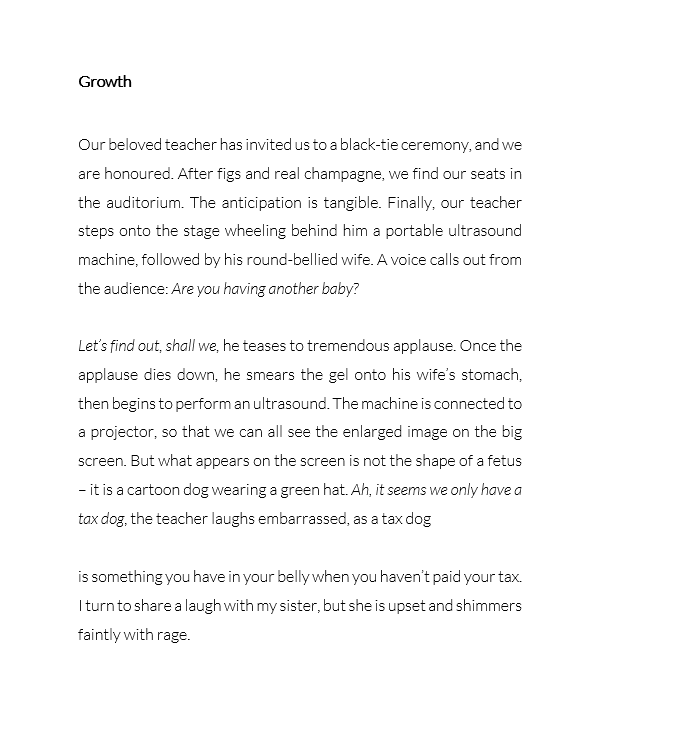
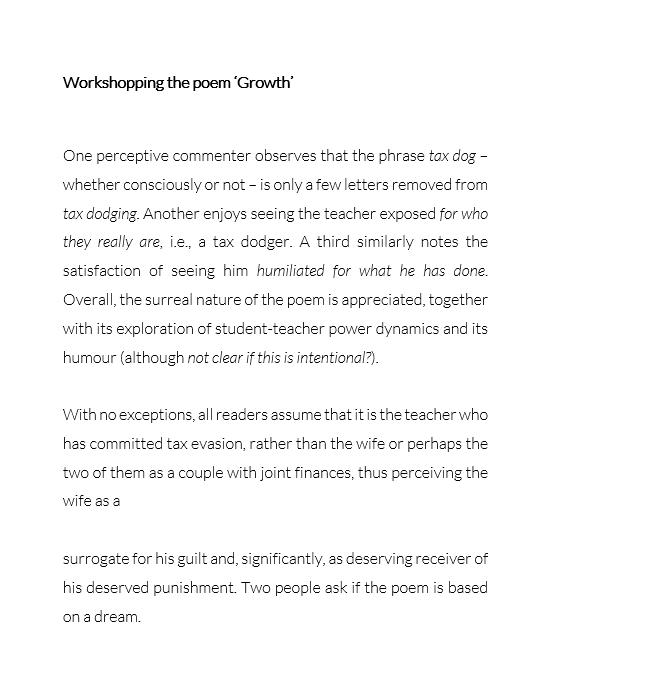
‘Growth’ – as hinted in ‘Workshopping the poem ‘Growth’’ – came out of a dream I couldn’t understand. Some of what a psychoanalyst might make of that dream only became clear to me once I’d written the poem and workshopped it, when someone for instance rightly pointed out the dream slip/condensation of ‘tax dog’ and ‘tax dodge’. But there was something in it too about desire: the audience’s desire for the teacher; the teacher’s desire for attention and spectacle; the sister’s more complex, thwarted desire. So what I added around the dream when writing the poem, like the figs and the sister herself, was meant to amplify these feelings of desire and aspiration.
Desire is also at the centre of ‘Destruction as the Cause of Coming into Being’. The poem’s original title was ‘Vejle’, after the Danish town near which I shared a cold dairy drink called koldskål with my partner. We sat on a pier by a still, misty lake, in that eerie light you get in Northern Europe during midsummer evenings. We poured the koldskål into a bowl we’d brought with us from the hotel, and weren’t sure if it was meant to be sour or if it had gone off.
I changed the title when I realised the poem itself had nothing to do with Denmark, but a lot to do with losing the edges of your individuality around a place or a person. The lines ‘I like it here so much that I’ve already / marked our graves in the yard’ paraphrase a letter Virginia Woolf sent about the house her and Leonard were planning to move into near Lewes. This association of joy and death seemed relevant to my poem. It also made me think about the connection many psychoanalysts claim exists between the sex drive and the death drive. The death drive – a concept often attributed to Freud, presumably due to a long-standing tendency to credit men for women’s thinking – was in fact coined by Russian analyst Sabina Spielrein, in an article titled ‘Destruction as the Cause of Coming into Being’.
And the misattribution of women’s work brings me back to ‘Workshopping the poem ‘Growth’’. This is, in a way, an interpretation of the poem ‘Growth’, which I now realise makes it very apt for ‘The Interpreter’s House’! I did actually workshop ‘Growth’ in an amazingly generous, insightful workshopping space, but later realised that most of the comments were focused on the teacher – and I myself had focused on the teacher when interpreting my dream. I didn’t understand why we all left out the wife. It seemed significant to me how easy it is to take agency away from women, for both ‘good’ and ‘bad’ acts, and suddenly I wanted the wife to be the tax dodger. I wondered, too, about the agency that we assign each other as poets – to what extent we give and receive credit for the ideas that we have conceived. I also just enjoyed writing a prose poem with line breaks.